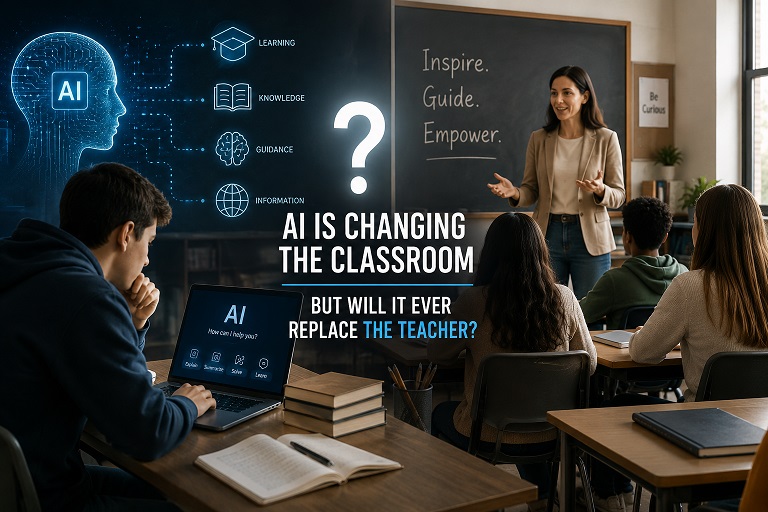
Artificial intelligence has entered the classroom faster than most schools were prepared for. Students can now generate essays, solve mathematics problems, explain scientific concepts, write code and summarize entire chapters within seconds.
This has created one of the biggest challenges modern education has faced:
If AI can do the homework, what exactly should students be learning?
And perhaps an even bigger question:
Do we still need teachers when every student can have an AI tutor available 24 hours a day?
The answer is not as simple as banning AI — or embracing it without limits.
Students Have Already Changed
Before generative AI, students searching for help with an assignment typically had to search Google, read websites, watch videos or ask someone for assistance.
Today, a student can simply ask an AI:
"Write my 1,000-word essay about climate change."
Seconds later, the assignment may be practically finished.
The problem is obvious.
The student may submit an excellent piece of work while understanding very little about the subject.
According to the OECD's Digital Education Outlook 2026, emerging evidence suggests that general-purpose generative AI can improve the quality of students' outputs without necessarily creating equivalent improvements in learning.
In other words:
Completing an assignment successfully is no longer proof that the student learned how to complete it.
That fundamentally changes education.
But AI Is Not Necessarily Bad for Students
There is another side to the story.
Imagine a student struggling with algebra at 10:30 at night.
Instead of waiting until the next school day, the student could ask AI:
"Don't give me the answer. Explain this equation step by step and then give me a similar problem to solve myself."
Now AI isn't replacing learning.
It is supporting it.
Students can use AI to:
- Explain difficult concepts in simpler language
- Generate practice questions
- Receive immediate feedback
- Practice foreign languages
- Brainstorm ideas
- Improve writing
- Understand programming errors
- Explore subjects beyond the curriculum
The difference is how AI is being used.
There is a huge educational difference between:
"Solve this for me."
and
"Teach me how to solve this."
Schools need to start teaching students that difference.
Has AI Replaced Teachers?
No — and trying to compare AI with teachers may misunderstand what a teacher actually does.
AI can explain the Pythagorean theorem.
It can generate 50 exercises about it.
It can even adapt those exercises according to a student's ability.
But teaching is more than delivering information.
A good teacher notices when a student has stopped participating.
A teacher recognizes frustration.
A teacher challenges a capable student who isn't making an effort.
Teachers create discussions, encourage curiosity, resolve disagreements and understand the personalities sitting in front of them.
Education contains a deeply human component that cannot simply be reduced to generating information.
UNESCO advocates a human-centered approach to generative AI in education, while the OECD argues that AI should strengthen teaching and learning rather than weaken the human relationships at the center of education.
AI therefore looks much more like a powerful educational assistant than a replacement for teachers.
Teachers Shouldn't Become AI Police
This may be one of the biggest mistakes schools can make.
Imagine a teacher spending the next decade constantly asking:
"Did ChatGPT write this?"
Students will find new tools.
AI will improve.
Detection methods will change.
And teachers and students will enter a permanent technological cat-and-mouse game.
Instead, schools should redesign some assignments so that simply generating an answer isn't enough.
If a student submits an essay, ask them to explain their argument verbally.
Ask:
Why did you reach this conclusion?
Which source influenced your argument?
What part of your essay would you change?
Can you defend your position without looking at the paper?
Suddenly, understanding matters again.
Homework Needs to Change
Traditional homework often evaluates the final product.
AI makes that increasingly unreliable.
A beautifully written essay could represent three hours of research and thinking.
Or three minutes with an AI chatbot.
Teachers therefore need to evaluate more of the learning process, not only the finished document.
For example, an assignment could require students to submit:
- Their initial idea
- Their research
- Their first draft
- How they used AI, if permitted
- What AI suggested
- What they rejected or corrected
- Their final answer
- A short classroom discussion about their conclusions
Now AI becomes part of the learning process instead of a machine that secretly completes the assignment.
What About Exams?
Examinations require a different approach.
There are still skills students need to demonstrate independently.
Foundational mathematics, writing, reasoning and subject knowledge cannot simply disappear because AI exists.
For important assessments, schools can continue using controlled examinations where AI isn't available.
But schools can also introduce a second type of assessment:
AI-allowed examinations.
Give students access to AI and test something different.
Can they identify an incorrect AI answer?
Can they improve a weak AI-generated argument?
Can they verify AI-generated information?
Can they recognize bias?
Can they ask effective questions?
Can they combine information from several sources and reach their own conclusion?
Those may become increasingly valuable skills in universities and workplaces where AI will actually be available.
Students Should Be Required to Disclose AI Use
Schools don't necessarily need a simple rule saying:
AI = cheating.
A more useful rule might be:
Undisclosed AI assistance = academic misconduct.
Students could include a simple declaration:
"I used AI to brainstorm ideas and check grammar. The arguments, research and final conclusions are my own."
Or:
"AI was not used for this assignment."
This teaches something bigger than compliance.
It teaches responsibility.
Teachers Also Need to Learn AI
There is an uncomfortable contradiction in education.
We cannot expect students to understand responsible AI use if their teachers aren't given opportunities to understand the technology themselves.
Teachers should experiment with AI.
Ask it to create lesson ideas.
Ask it to explain something badly.
Find its mistakes.
Compare different answers.
Use it to create practice questions.
Then understand where it succeeds — and where it fails.
The OECD reported that 37% of lower-secondary teachers were already using AI for their work in 2024, while 72% believed AI could harm academic integrity by enabling students to present AI-generated work as their own.
Teachers therefore need training, not simply another rulebook.
The Bigger Danger Isn't AI
The biggest danger may not be students using artificial intelligence.
It may be students becoming dependent on it.
A calculator is extraordinarily useful.
But imagine someone who cannot perform basic arithmetic without one.
AI could create the same problem on a much larger scale.
If students stop writing because AI writes better, stop researching because AI summarizes faster, stop solving problems because AI provides answers and stop questioning because AI sounds confident, education has failed.
Students need to learn something extremely important:
Use AI to extend your thinking — not replace it.
Education Has Faced This Before
Calculators didn't eliminate mathematics.
Google didn't eliminate schools.
Wikipedia didn't eliminate teachers.
YouTube didn't eliminate universities.
Each technology changed how information was accessed and forced education to adapt.
Generative AI is another transformation — although potentially a much larger one.
Trying to completely remove AI from students' lives is unlikely to prepare them for a world in which AI will increasingly be embedded in workplaces, software and everyday tools.
Allowing AI to think for students isn't the answer either.
The challenge is finding the space between those extremes.
The Teacher of the Future
The teacher's role may actually become more important.
When information becomes almost unlimited, students need someone who can teach them which information deserves to be trusted.
When machines can generate answers instantly, students need someone who teaches them how to ask better questions.
When AI can write an argument, students need someone who teaches them how to challenge it.
And when technology makes completing a task effortless, teachers must ensure that students still experience the difficult intellectual process through which genuine learning happens.
AI probably won't replace great teachers.
But it will change what being a great teacher means.
The classrooms that succeed won't necessarily be those that ban AI or those that use it everywhere.
They will be the classrooms that teach students one principle:
Artificial intelligence should help you think further — never become a substitute for thinking.
Sources
- OECD — Digital Education Outlook 2026: Exploring Effective Uses of Generative AI in Education
- OECD — Reimagining Teaching in an Accelerating World
- UNESCO — Guidance for Generative AI in Education and Research
KJoumaa Technology & Development Blog